How Body Dysmorphic Disorder Warps Visual Processing
- Published19 Aug 2026
- Author Dina Radtke
- Source BrainFacts/SfN
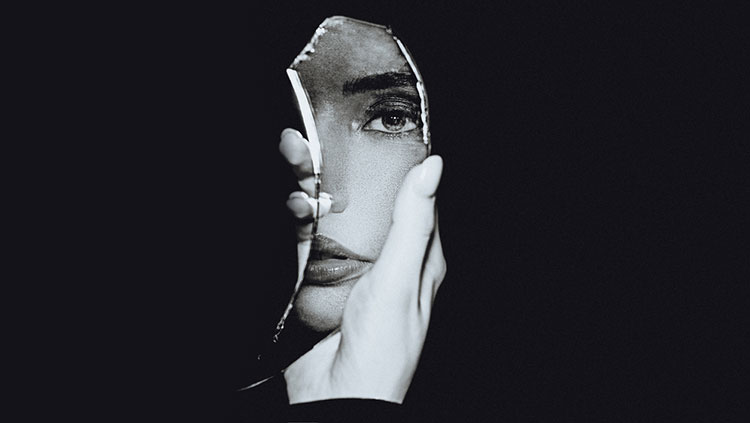
At some point in our lives, most of us experience insecurities about how we look, but we can recognize perceived imperfections don’t define our entire appearance. For people with body dysmorphic disorder (BDD), minor traits can appear as major defects, and neuroscience research is starting to explain why.
BDD is a psychiatric condition related to obsessive-compulsive disorder (OCD). Like an endless doomscroll, the BDD brain ruminates over areas of the face or body it perceives as unattractive, replaying repulsive thoughts that don’t match what others see.
This often leads to compulsive mirror-checking and desperate attempts to hide or change one’s physical appearance — often with plastic surgeries that fail to provide relief.
As social media feeds pile on videos of meticulous skincare routines, ab-blasting workouts, and “looksmaxxing” content, researchers worry our digital environments may be worsening BDD-like symptoms for some.
The anxious brain amplifies “imperfections”
Our brains evolved to help us survive life-threatening situations, and a person with extreme body dissatisfaction can view their so-called flaws as dangerous to their livelihood. Detecting a threat, the visual system homes in on loathed features or blemishes.
Evolutionarily, “in certain fight or flight scenarios, you’d want to be able to pick out details … like being able to see a tiger’s eyes in a bush,” said Jamie Feusner, a psychiatrist and researcher from the University of Toronto. “You wouldn’t want to see the overall contour of a bush. You need to see things that are threatening to you, and details can provide that information.”
An uncontrollable obsession with looks means that for the BDD brain, just peering into the mirror can generate a strong fear response.
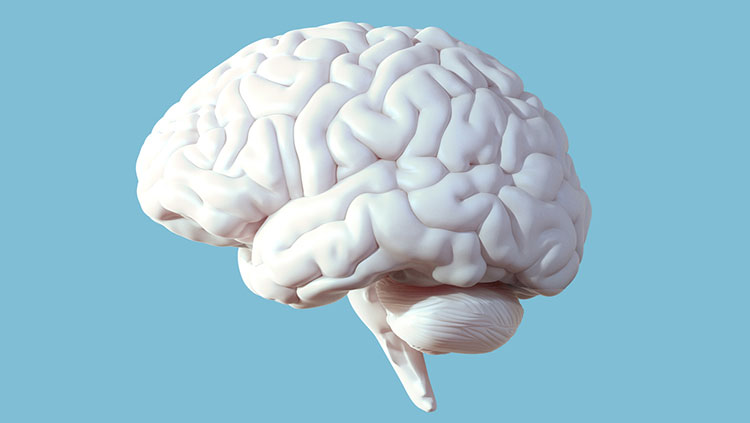
The amygdala, a key brain region for assessing emotions like anxiety and fear, is connected to part of the visual cortex known as the ventral visual stream (VVS). The area contains millions of specialized neurons that process the details of what we see.
In states of anxiety, activity in the amygdala can signal the VVS to zero in on threat-relevant details. If the fear stems from anxiety about one’s ear size or nose shape, what’s seen in the mirror can disproportionately focus attention on that area of concern.
People with BDD tend to show relatively high activation in the VVS, the detail-processing region, and relatively low activation in the dorsal visual stream (DVS), which is responsible for whole picture processing.
This functional pattern puts minor features into focus, hindering the brain’s ability to contextualize them as small pieces of a larger picture. It’s the equivalent of gazing at a painting and hyper focusing on the brush strokes, missing how those details constellate to create a masterpiece.
Fear-based face scanning
The visual misperceptions also seep into social interactions. While looking at others, individuals with BDD show disorganized eye-scanning patterns, leading to social confusion and further distress.
“When healthy people are scanning a face, they look across the eyes and down to the mouth and then up to the nose,” the parts of the face most useful for interpreting nonverbal information, said Susan Rossell, a cognitive neuropsychologist at Swinburne University of Technology in Melbourne.
In BDD, the eyes go to features of the face that may be irrelevant for social communication, but important for social comparison. A person preoccupied with their own ears, for example, is likely to fixate on the ear size or shape of whoever is speaking, pulling attention away from a subtle lifting of the lips’ corners or a kind expression around the eyes.
The brain then assesses others’ emotions with limited information. Consistent with this, those with BDD are more likely to perceive other peoples’ expressions as negative even when they’re neutral, which can aggravate existing beliefs about being unattractive.
Learning to overvalue looks
An intense fear of being perceived as undesirable stems, in part, from social conditioning overemphasizing attractiveness as essential to one’s success. And research suggests our digital worlds could be exacerbating perfectionist attitudes.
“Social media is a comparison machine,” said Sam Most, chief of the facial plastic and reconstructive surgery division at Stanford University School of Medicine. “You're constantly measuring yourself against everyone else's curated best moments — and increasingly, against faces that have been filtered and edited to the point that they don't exist in real life.”
Most and his colleagues are concerned certain forms of social media might be driving BDD-like symptoms that lead people to seek aesthetic surgeries. He emphasized the importance of careful psychological screening before undergoing any procedure.
“I see the downstream effects in my own practice,” Most shared. “Patients coming in with edited photos of themselves as the goal, expecting a result that no surgery can deliver.”
In a 2025 survey of more than 1,000 American adults published in Facial Plastic Surgery & Aesthetic Medicine, Most and his colleagues found people who screened positive for body dysmorphic symptoms spent more time on social media than those who didn’t. They were also more likely to be considering plastic surgery.
Younger groups showed higher rates of both social media use and body image concerns. 35% of Gen Z respondents screened positive on the Body Dysmorphic Disorder Questionnaire (BDDQ), compared to 25% of respondents overall. The typical Gen Z respondent reported about six hours of social media use per day — compared to four hours across all age groups.
Screening positively for body dysmorphic symptoms is not the same as a formal BDD diagnosis. “What the screen really picks up is serious dissatisfaction with your own appearance,” said Most.
But body dissatisfaction can contribute to similar symptoms and behaviors.
Experts believe image-based platforms like Facebook, Instagram, and TikTok may be particularly harmful to body image.
“The most popular platforms are built around photos, and the algorithms reward exactly the kind of idealized imagery that makes people feel inadequate,” said Most.
It’s not yet clear whether multi-hour scrolling increases one’s risk for body dysmorphic symptoms, or if those with existing symptoms are simply more likely to use the platforms in an unhealthy way. Some experts have suggested a bidirectional relationship — those prone to appearance obsessions likely use social media in ways that worsen symptoms.
Not everyone who uses social media in such a way will develop symptoms that reach the level of clinical BDD. Like most psychiatric disorders, there is a strong genetic influence.
“There are people that have some kind of sets of genes that probably make them more liable to develop this,” said Feusner.
But experts note adolescents are at a higher risk of developing BDD or its related symptoms. Consuming an onslaught of glamorized beauty and exercise videos could prime the developing brain to place excessive value on appearance — potentially leading to thought and visual patterns that create a skewed picture of self.
About the Author

Dina Radtke is the Media Associate & Science Writer for the Society for Neuroscience. Previously, she was a researcher for Media Matters for America where she analyzed media coverage and fact-checked misinformation. She holds a Bachelor of Arts in Spanish Language & Literature from the University of Colorado Boulder.
CONTENT PROVIDED BY
BrainFacts/SfN
References
Diaz-Fong J. P. & Feusner J. (2025). Visual Perceptual Processing Abnormalities in Body Dysmorphic Disorder. Curr Top Behav Neurosci, 74:105–127. doi: 10.1007/7854_2024_472
Enander J., Ivanov V. Z., Mataix-Cols D., Kuja-Halkola R., Ljótsson B., Lundström S., Pérez-Vigil A., Monzani B., Lichtenstein P., Rück C. (2018). Prevalence and heritability of body dysmorphic symptoms in adolescents and young adults: a population-based nationwide twin study. Psychol Med, 48(16):2740–2747. doi: 10.1017/S0033291718000375
Losorelli, S., Kandathil, C. K., Saltychev, M., Wei, E. X., Rossi-Meyer, M. K., Most, S. P. (2025) Association Between Symptoms of Body Dysmorphia and Social Media Use: A Cross-Generational Comparison. Facial Plastic Surgery & Aesthetic Medicine. DOI:10.1089/fpsam.2024.0230
Grace S. A., Lin Toh W., Buchanan B., Castle D. J., Rossell S. L. (2019). Impaired Recognition of Negative Facial Emotions in Body Dysmorphic Disorder. Journal of the International Neuropsychological Society, pp. 884-889. doi: https://doi.org/10.1017/S1355617719000419
Gupta M., Jassi A., Krebs G. (2023). The association between social media use and body dysmorphic symptoms in young people. Front Psychol.14:1231801. doi: 10.3389/fpsyg.2023.1231801.
Virgili G., Neill E., Enticott P., Castle D. J., Rossell S. L. (2024). A systematic review of visual processing in body dysmorphic disorder (BDD). Psychiatry Research, 339:116013. doi: 10.1016/j.psychres.2024.116013