
Synopsis
In this activity, students will simulate how an action potential is generated in a neuron using dried peas and beans to represent ions. By modeling the movement of ions across the cell membrane, students will explore how changes in membrane potential produce the electrical signals that allow neurons to communicate.
Estimated time needed: 1–2 class periods.
Objectives
- By the end of this lesson, students will be able to:
- Predict the movement of sodium (Na⁺) and potassium (K⁺) across a membrane.
- Explain how ion distributions contribute to the resting membrane potential.
- Model the electrical and chemical changes that occur during an action potential.
- Describe the roles of sodium and potassium channels in depolarization and repolarization.
Integration Into the Curriculum
- Biology, AP Biology
- Anatomy and Physiology
Materials
For each group of four students:
- Dried black-eyed peas (sodium ions, Na⁺)
- Dried baby lima beans (potassium ions, K⁺)
- 4 pie or cake pans (~20–22 cm or ~8–9 in)
- 5 sheets construction paper
- 1 sheet of cardboard (~106 x 90 cm or ~40 x 35 in)
- 2 toothpicks
- 1 marking pen
- 1 metric ruler
- Post-it notes (optional)
Teacher Background: Neurons Fire Electrical Signals
Preparing Students for the Activity
Before beginning the activity, students should have a basic understanding of how neurons communicate and how electrical signals are generated. Before the lesson, students can watch How Neurons Communicate from BrainFacts, where they learn that neurons communicate using electrical and chemical signals, that action potentials are electrical signals traveling along neurons, and that these electrical signals trigger the release of chemical messengers (neurotransmitters) between cells at synapses.
For additional background, students and teachers may read these BrainFacts primers:
Teachers can also refer to this Action Potential Interactive simulation, built by the University of Colorado Boulder and PhET Interactive Simulations, for a brief introduction or review accompanying this activity.
Educator Background
Neurons communicate using electrical signals created by the movement of ions across the cell membrane. Two ions play especially important roles in this process: sodium (Na⁺) and potassium (K⁺).
At rest, sodium ions are more concentrated outside the neuron, while potassium ions are more concentrated inside. Because of these unequal ion distributions and the presence of negatively charged molecules inside the cell, the inside of a resting neuron is more negative than the outside. This difference in charge is called the resting membrane potential.
When a neuron receives enough stimulation to reach threshold, sodium channels open and sodium ions flow into the cell. This causes the inside of the neuron to become more positive, a process called depolarization.
Shortly afterward, sodium channels close and potassium channels open. Potassium ions move out of the cell, causing the membrane potential to return toward its resting state. This process is called repolarization.

Together, depolarization and repolarization help form an action potential, the electrical signal that travels along the axon and allows neurons to communicate with other cells. In this activity, students model these ion movements to explore how action potentials are generated.
Key Vocabulary
- Membrane potential: Difference in electrical charge across a cell membrane.
- Resting membrane potential: The membrane potential of a neuron at rest (about −70 mV).
- Threshold: The membrane potential required to trigger an action potential.
- Depolarization: The membrane becomes more positive.
- Repolarization: The membrane returns toward its resting negative state.
- Action potential: A rapid electrical signal generated by the movement of ions across the membrane.
Exploration Activity
Part 1: Build a Resting Neuron
- Assign roles in each group of four students:
- 2 materials coordinators
- 1 bean (ion) mover
- 1 data recorder
- Have the materials coordinators prepare the ion pans as follows:
- Sodium ions (black-eyed peas): many in one pan, few in another
- Potassium ions (baby lima beans): many in one pan, few in another
- Prepare the model membrane:
- Draw a line down the center of the cardboard representing the cell membrane.
- Leave two gaps to represent ion channels.
- Place toothpicks across the gaps to “close” the gates
- Label one side “inside the cell” and the other “outside the cell”
- Place the ions:
- Most sodium ions outside the cell.
- Most potassium ions inside the cell.
- Place a note marked “negative” on the inside of the cell and “positive” on the outside.
- (Optional) Add intracellular components:
- Crumple construction paper into balls and place them inside the cell.
- Explain that these large negatively charged proteins cannot cross the membrane.
- Record observations:
- Which ion is most concentrated outside the cell?
- Which ion is most concentrated inside the cell?
- What is the overall charge inside the neuron?
Part 2: Depolarization
- Explain that the neuron has reached threshold.
- Open the sodium channel.
- Before moving ions, have students predict:
- Which direction sodium ions will move.
- Whether the inside of the neuron will become more positive or more negative.
- Move sodium ions through the channel for a set timed interval.
- Record observations:
- Are there more sodium ions inside the cell?
- Has the inside become more positive?
- Is the neuron depolarizing?
Part 3: Repolarization
- Close the sodium channel and open the potassium channel.
- Before moving ions, have students predict:
- Which direction potassium ions will move.
- Whether the inside of the neuron will become more positive or more negative.
- Move potassium ions through the membrane for the set timed interval.
- Record observations:
- Are there fewer potassium ions inside the cell?
- Has the inside become more negative?
- Is the neuron repolarizing?
Modeling an Action Potential
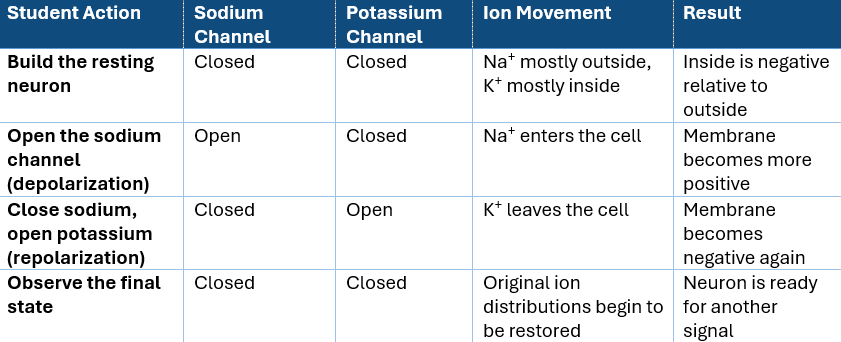
Teacher Note: Students often assume that sodium and potassium channels are open at the same time. Emphasize that during this model, students should open the sodium channel first to simulate depolarization. After the sodium channel is closed, they should open the potassium channel to simulate repolarization.
Lesson Wrap-Up: What’s Happening?
Neurons maintain different concentrations of ions inside and outside the cell membrane.
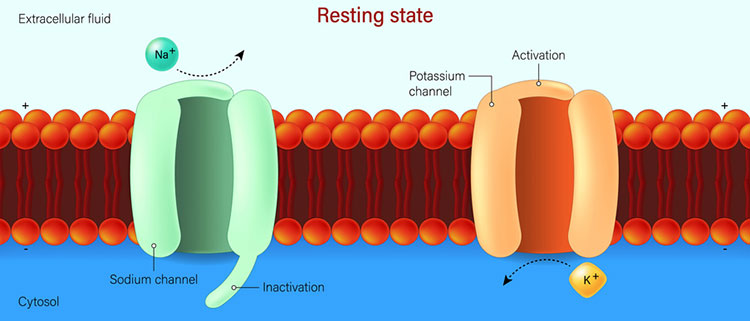
At rest, sodium ions (Na⁺) are more concentrated outside the neuron, while potassium ions (K⁺) are more concentrated inside. Because of these ion distributions and the presence of negatively charged proteins inside the cell, the inside of the neuron is more negative than the outside. This difference in charge is called the resting membrane potential, which is approximately -70 mV.
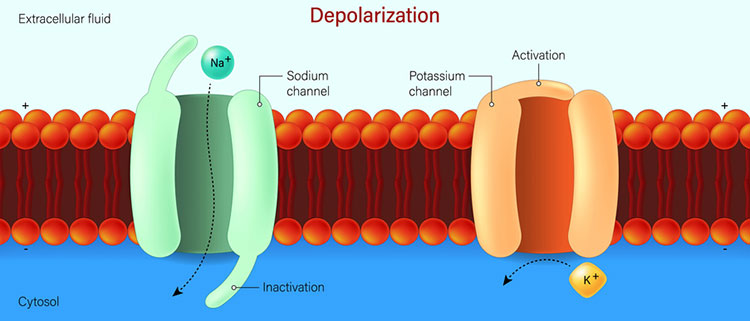
When a neuron receives enough stimulation to reach threshold, voltage-gated sodium channels open. Sodium ions move into the cell, causing the membrane potential to become less negative and then positive. This process is called depolarization.

Shortly afterward, sodium channels close and potassium channels open. Potassium ions move out of the cell, causing the membrane potential to return toward its resting value. This process is called repolarization.
The rapid sequence of depolarization followed by repolarization creates an action potential, an electrical signal that travels down the axon. When the action potential reaches the axon terminal, it can trigger communication with other neurons through the release of neurotransmitters.
(Optional) Deeper Dive: Hyperpolarization
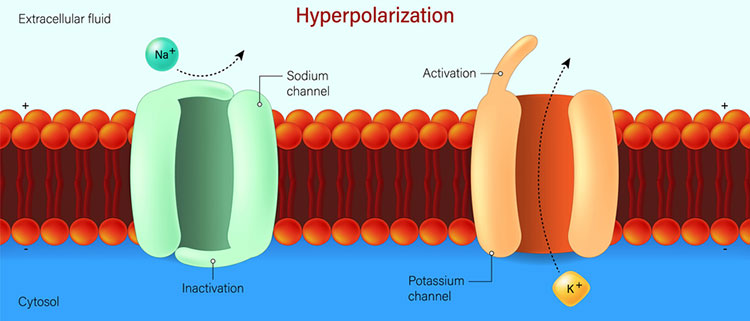
Sometimes potassium channels remain open slightly longer than necessary, allowing additional potassium ions to leave the cell. As a result, the membrane potential briefly becomes even more negative than the resting membrane potential. This phase is called hyperpolarization. During hyperpolarization, the neuron is less likely to generate another action potential. This brief period helps ensure that action potentials travel in one direction and prevent neurons from firing repeatedly without sufficient stimulation.
After the action potential has passed, cellular mechanisms help restore the original ion distributions, preparing the neuron to generate another signal.
CONTENT PROVIDED BY
BrainFacts/SfN
Discussion Questions
-
Why did sodium move into the neuron?
-
Why did potassium move out of the neuron?
-
What caused the membrane potential to become more positive?
-
What caused the membrane potential to become negative again?
-
Why must sodium channels close before potassium channels open?
-
How do these changes create an action potential?