Where’s That Sound Coming From? Activity Guide
- Published27 Jul 2026
- Source BrainFacts/SfN

Synopsis
In this activity, students will explore how our sense of hearing generally works. Afterwards, students will participate in an exercise that demonstrates the brain’s ability to identify the location of a sound. Students can then design their own experiments to examine other characteristics of the sense of hearing.
Estimated time needed: 1–2 class periods.
Objectives
By the end of this lesson, students will be able to:
- Explain how the ear and/or brainstem determine the location of sounds using external input.
- Design an experiment to investigate a characteristic of the sense of hearing.
Integration Into the Curriculum
- Health
- Biology, AP Biology
- Anatomy and Physiology
Materials
For each group of 12 students:
- 1 blindfold
- 8 chopsticks (or objects that make noise)
- 8 sticky notes (optional)
- 1 meter stick or tape measurer (optional)
- Adhesive tape (or chalk if outside)
- 1 location chart (Figure 2)
- 1 data chart (Figure 3)
- 1 pair of ear covers or headphones
For the classroom:
- A device capable of playing video and audio (laptop, tablet, or similar)
- Copies of Figures 2 and 3 (projected on screen, shared digitally, or printed out)
Teacher Background: How Sound Travels Through the Ear
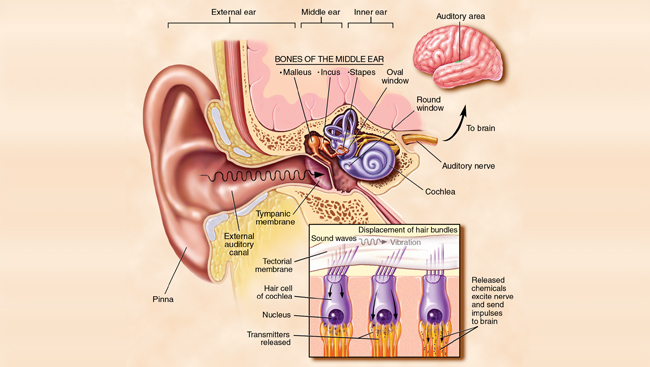
Before beginning the activity, students should have a general understanding of how sound travels through the ear. To build this foundation, students can begin with a self-exploration of the hearing process. Students may also watch “Journey of Sound to the Brain” from the National Institute on Deafness and Other Communication Disorders, which provides a broad overview of how sound waves move through the ear and are processed by the brain.
After viewing the video, students can read “How Hearing Works” from BrainFacts, which explains more of the mechanics of hearing in detail, including information on biological structures and how sound is translated into neural signals.
Exploration Activity
- Assign a group of 12 students these roles: 1 listener, 1 pointer, 1 data recorder, 1 group discussion coordinator, and 8 noisemakers.
- If possible, remove the listener from the room. If not possible, the listener should be blindfolded and positioned somewhere they hear as little noise as possible.
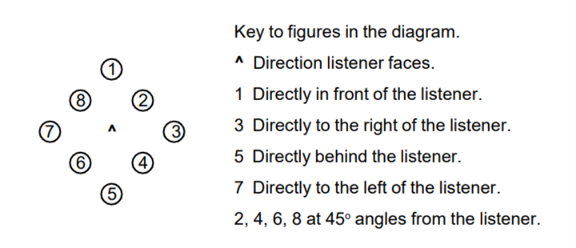 Figure 2. Exploration Activity Setup: “Where’s That Sound Coming From?” Arrange noisemakers in a circle, each one meter away from the center where the listener will be positioned. Each noisemaker can wear a sticky note, each numbered 1–8, to denote where they should be in the circle. The sticky notes should be visible to the pointer and data recorder.BrainFacts/Society for Neuroscience
 - Place an “X” down on the floor with adhesive tape or drawn on the ground. Arrange noisemakers in a circle, each 1 meter away from the center where the listener will be positioned. Each noisemaker can wear a sticky note, each numbered 1-8, to denote where they should be in the circle. (See Figure 2 for setup.) The sticky notes should be visible to the pointer and data recorder.
- The pointer should give each noisemaker a set of chopsticks (or noise-making objects) and demonstrate how to make a consistent sound. Noisemakers should practice creating uniform sounds amongst the group.
- Blindfold the listener prior to coming into the room. Guide them to the center of the circle. Instruct them to remain stationary and not move their head.
- The pointer should randomly point at one of the noisemakers to make a sound with the chopsticks.
- Without moving their head, the listener should point toward where they perceived a sound.
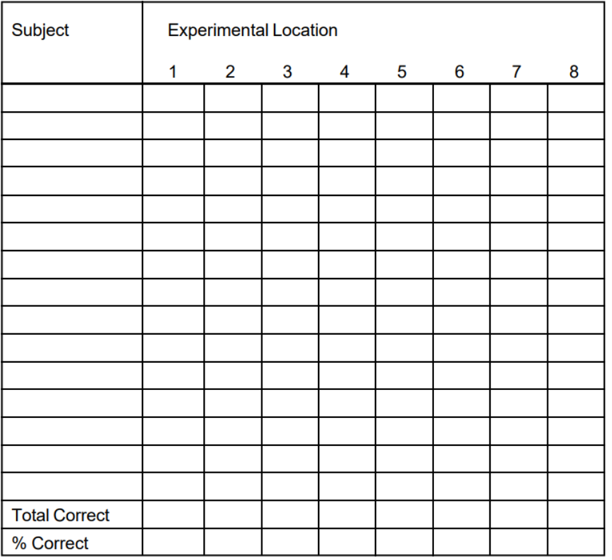 Figure 3. Sample Data Recorder Sheet: “Where’s That Sound Coming From?” The data recorder should mark correct (Y) or incorrect (N) responses to whether the listener pointed in the correct direction of the sound (across noisemaker locations 1–8).BrainFacts/Society for Neuroscience
 - The data recorder should mark correct (Y) or incorrect (N) responses to whether the listener pointed in the correct direction of the sound. (See Figure 3 for sample data recorder sheet.) Repeat steps 6–8 for about three minutes.
- At the end of three minutes, the listener may remove the blindfold. The data recorder will tally the correct and incorrect responses for each position and read these data out loud for the members of the group. Group members should record this information or receive a copy of the data recorder’s sheet.
- Place discussion questions on the board for group data analysis, or give discussion questions to the group discussion coordinators to use while monitoring the brainstorm portion of the activity. (See “Discussion Questions” below.)
- Suggest that the students summarize their findings. Then have the groups share their ideas with the class. By comparing notes and with teacher guidance, students will be able to see for themselves what issues they understand and where they need further assistance.
Lesson Wrap-Up: What’s Happening?
If the sound is closer to the right side of the body, it will arrive at the right ear before it arrives at the left ear — and be louder on the right side. These tiny differences in time and intensity help the brain pinpoint the location of a sound.
Both ears send signals to a part of the brainstem where information from the two ears is compared. Certain brain cells here act like very precise timing detectors: They fire most strongly when signals from both ears arrive at exactly the same moment. By detecting which timing pattern produces the strongest response, your brain can determine whether a sound came from the left, right, or somewhere in between.
However, this ability makes it challenging for the brain to determine whether a sound originates from directly in front or directly behind. Since a sound from the front and back reaches both ears at nearly the same time, the brain relies on other clues, such as sight or touch, to detect the sound's location.
The brain is naturally able to locate sounds, but experience helps improve this sense. Over time, your brain gets better at interpreting these signals, especially in noisy or complex environments, so you can more accurately tell where sounds come from.
CONTENT PROVIDED BY
BrainFacts/SfN
Discussion Questions
- Which locations were easiest or hardest to identify? What do these have in common?
- How might you explain the patterns of responses in each of the following locations:
- 3 and 7 compared with 1 and 5?
- 3 and 7 compared with 2, 4, 6, and 8?
- 1 and 5 compared with 2, 4, 6, and 8?
- Did you notice if the listener hesitated longer in responding to sounds coming from some locations than from others? How might you explain these differences?